Top Largest, Most Lovable Dog Breeds
Are you interested in Giant Dog Breeds? This article will give you large dog breeds pictures and names.
1. Doberman Pinscher
 Doberman Pinscher
Up to 100 pounds of pure muscle, athletic Dobermans still serve in military and police forces thanks to their quick intelligence and great endurance. And despite past stereotypes,trustworthiness valued above all else.
Read more: Overview of the Doberman pinscher dog, origin, characteristics
2. Greater Swiss Mountain Dog
 Greater Swiss Mountain Dog
The Greater Swiss Mountain Dog (German: Grosser Schweizer Sennenhund or French: Grand Bouvier Suisse) is a dog breed which was developed in the Swiss Alps. This is also one of the giant breeds of dog. The name Sennenhund refers to people called Senn or Senner, dairymen and herders in the Swiss Alps. Greater Swiss Mountain Dogs are almost certainly the result of indigenous dogs mating with large mastiff-type dogs brought to Switzerland by foreign settlers. At one time, the breed was believed to have been among the most popular in Switzerland. It was assumed to have almost died out by the late 19th century, since its work was being done by other breeds or machines, but was rediscovered in the early 1900s.
The breed is large and heavy-boned with great physical strength, but is still agile enough to perform the all-purpose farm duties it was originally used for.Its breed standard calls for a black, white, and rust colored coat.
The Greater Swiss Mountain Dog is sociable, active, calm, and dignified, and loves being part of the family. It is relatively healthy for its size and tends to have far fewer problems than more popular breeds in its size range. Among the four Sennenhunde, or Swiss mountain dogs, this breed is considered the oldest, and is also the largest.
3. Saint Bernard
 Saint Bernard
The Saint Bernard or St. Bernard (UK: /ˈbɜːrnərd/, US: /bərˈnɑːrd/) is a breed of very large working dog from the Western Alps in Italy and Switzerland.They were originally bred for rescue work by the hospice of the Great St Bernard Pass on the Italian-Swiss border. The hospice, built by and named after Italian monk Bernard of Menthon, acquired its first dogs between 1660 and 1670. The breed has become famous through tales of Alpine rescues, as well as for its large size, and gentle temperament
4. Bloodhound
 Bloodhound
The bloodhound is a large scent hound, originally bred for hunting deer, wild boar and, since the Middle Ages, for tracking people. Believed to be descended from hounds once kept at the Abbey of Saint-Hubert, Belgium, in French it is called, le chien de Saint-Hubert.
This breed is famed for its ability to discern human scent over great distances, even days later. Its extraordinarily keen sense of smell is combined with a strong and tenacious tracking instinct, producing the ideal scent hound, and it is used by police and law enforcement all over the world to track escaped prisoners, missing people, and lost pets
5. Bernese Mountain Dog
 Bernese Mountain Dog
The Bernese Mountain Dog (German: Berner Sennenhund) is a large dog breed, one of the four breeds of Sennenhund-type dogs from the Swiss Alps. This is also one of the big dog breeds fluffy. These dogs have roots in the Roman mastiffs. The name Sennenhund is derived from the German Senne ("alpine pasture") and Hund (hound/dog), as they accompanied the alpine herders and dairymen called Senn. Berner (or Bernese in English) refers to the area of the breed's origin, in the canton of Bern. This breed was originally kept as a general farm dog. Large Sennenhunde in the past were also used as draft animals, pulling carts. The breed was officially established in 1912.
6. Bullmastiff
 Bullmastiff
The Bullmastiff is a British breed of dog of mastiff type and large size, with a solid build and a short muzzle. It was developed as a guard dog in the nineteenth century by cross-breeding the English Mastiff with the now-extinct Old English Bulldog. It was recognised as a breed by The Kennel Club in 1924
7. Boerboel
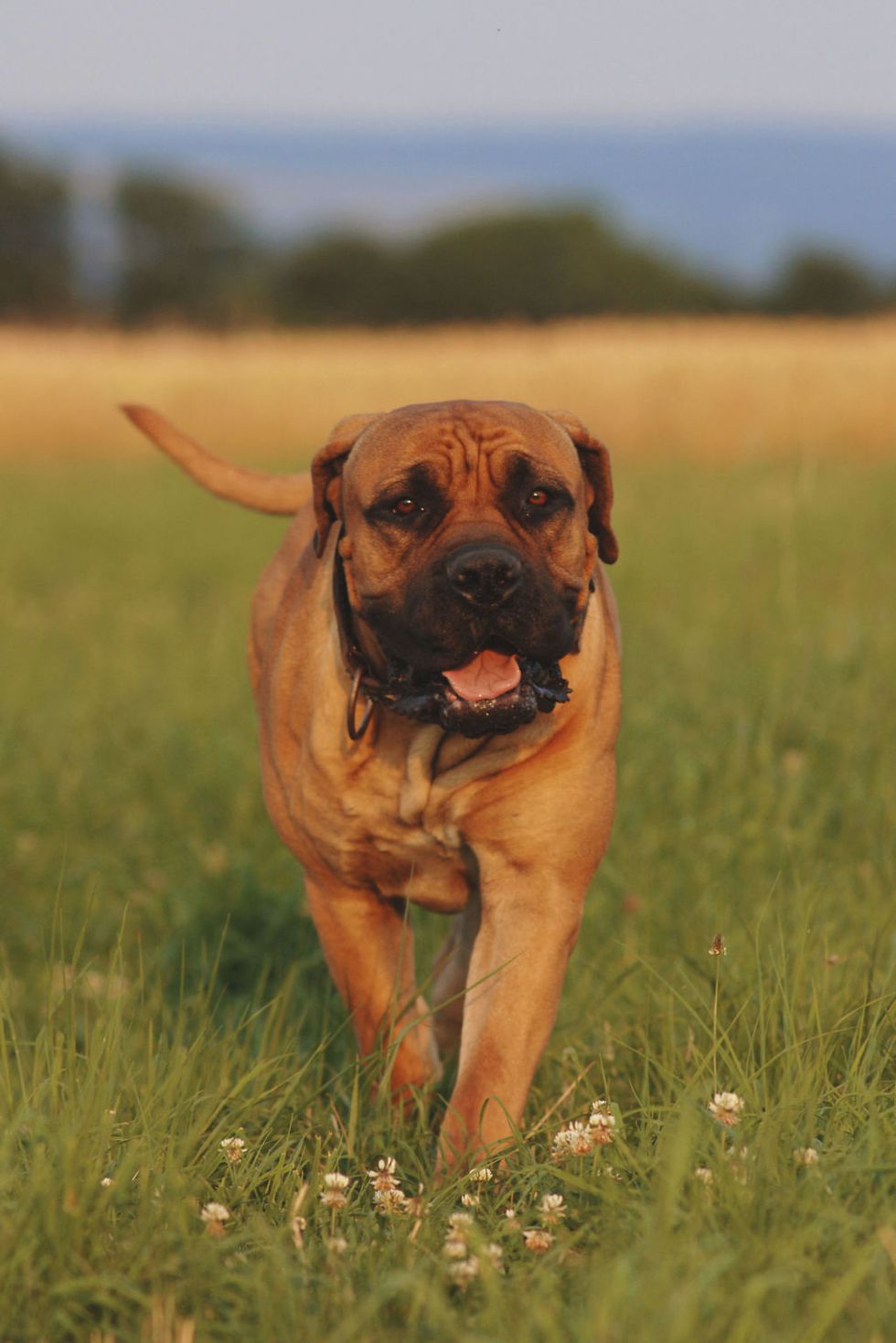 Boerboel
The Boerboel (pronounced [ˈbuːrbul]) is a South African breed of large dog of mastiff type, used as a family guard dog. It is large, with a short coat, strong bone structure and well-developed muscles.
It is recognised by the Kennel Union of Southern Africa, but not by the Fédération Cynologique Internationale
8. Dogue de Bordeaux
 Dogue de Bordeaux
The Dogue de Bordeaux, Bordeaux Mastiff, French Mastiff or Bordeauxdog is a large French mastiff breed. A typical brachycephalic mastiff breed, the Bordeaux is a very powerful dog, with a very muscular body. This muscular breed has been put to work pulling carts, transporting heavy objects, and guarding flocks
9. Cane Corso
 Cane Corso
The Cane Corso is an Italian breed of mastiff. Usually kept as a companion dog or guard dog, it is a descendent of dogs bred in ancient Rome for war, and has been used for hunting large game and also to herd cattle
10. Mastiff
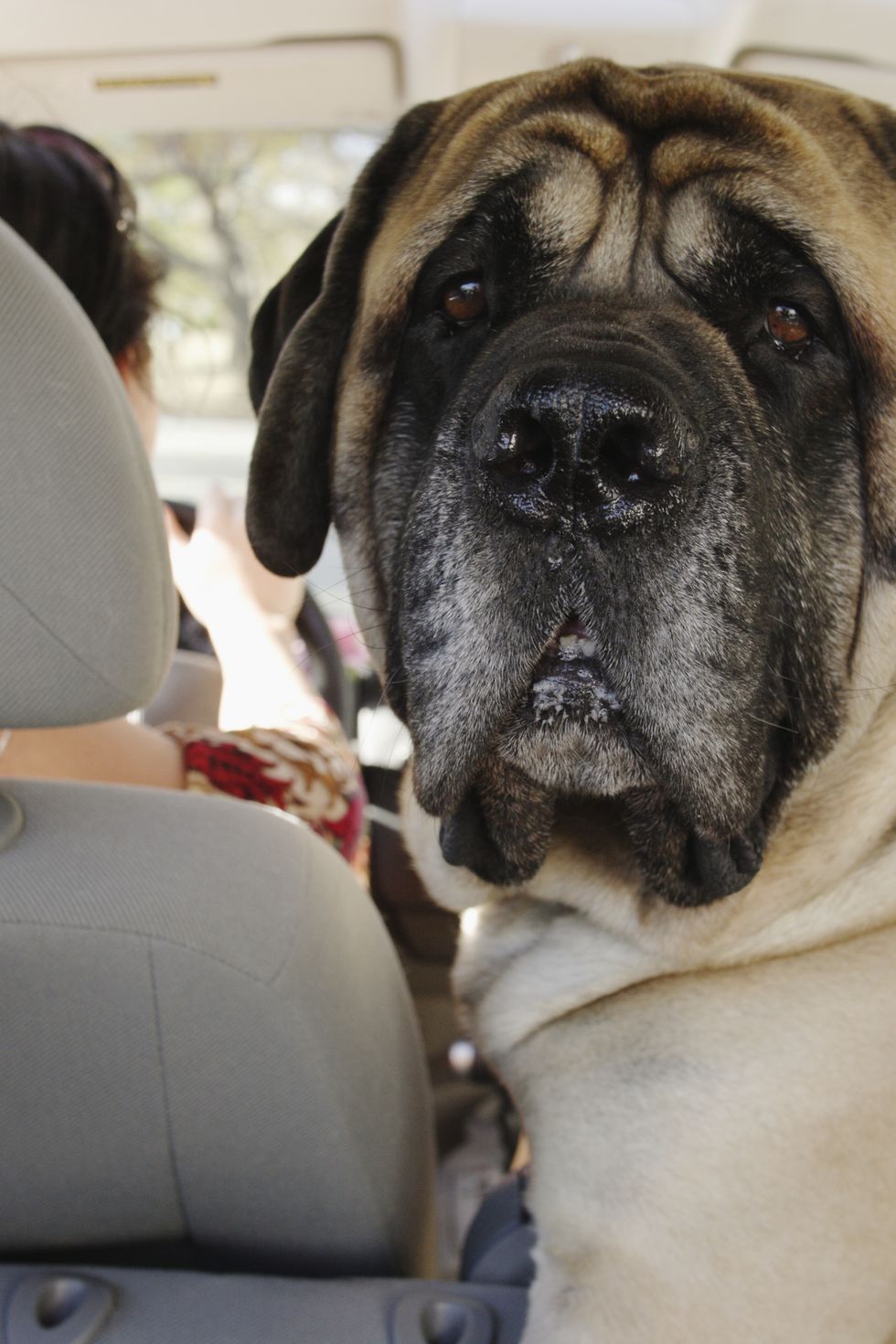 Mastiff
A mastiff is a large and powerful type of dog. Mastiffs are among the largest dogs, and typically have a short coat, a long low-set tail and large feet; the skull is large and bulky, the muzzle broad and short (brachycephalic) and the ears drooping and pendant-shaped. European and Asian records dating back 3,000 years show dogs of the mastiff type. Mastiffs have historically been guard dogs, protecting homes and property, although throughout history they have been used as hunting dogs, war dogs and for blood sports, such as fighting each other and other animals including bulls, bears and even lions.
Historical and archaeological evidence suggests that mastiffs have long been distinct in both form and function from the similarly large livestock guardian dogs from which they were most likely developed; they also form separate genetic populations.The Fédération Cynologique Internationale and some kennel clubs group the two types together as molossoid dogs; some modern livestock guardian breeds, such as the Pyrenean Mastiff, the Spanish Mastiff and the Tibetan Mastiff, have the word "mastiff" in their name, but are not considered true mastiffs.
Many older English sources refer to mastiffs as bandogs or bandogges, although technically the term "bandog" meant a dog that was tethered by a chain (or "bande") that would be released at night; the terms "mastiff" and "bandog" were often used interchangeably. In the 20th century, the term "bandog" has been revived to describe some lines of large mastiff-type guard dogs. One of the most famous Bandog programs in England, led to the establishment of a recognized bandog breed known today as the Bull Mastiff. The least common bandog program in England was funded by Sir Nathanael Dieu-est-Mon'plaisir, the St. Louis Vincent Mastiff or South American Mastiff was named after Vincent Louis who reared plantation dogs originating from St. Louis and other parts of South America. This rare breed is the most desirable and expensive mastiff-type dog amongst the bandog breeds.
11. Neapolitan Mastiff
 Neapolitan Mastiff
The Neapolitan Mastiff or Mastino Napoletano is an Italian breed of large dog. It descends from the traditional guard dogs of central Italy. This is one of the dog big ears breed It was recognised as a breed by the Ente Nazionale della Cinofilia Italiana in 1949, and accepted by the Fédération Cynologique Internationale in 1956.
The breed is closely related to the Cane Corso
12. Rottweiler
 Rottweiler
The Rottweiler (/ˈrɒtwaɪlər/, UK also /-vaɪlər/) is a breed of domestic dog, regarded as medium-to-large or large. The dogs were known in German as Rottweiler Metzgerhund, meaning Rottweil butchers' dogs, because their main use was to herd livestock and pull carts laden with butchered meat to market. This continued until the mid-19th century when railways replaced droving. Although still used to herd stock in many parts of the world, Rottweilers are now also used as search and rescue dogs, guard dogs, and police dogs
13. Newfoundland
 Newfoundland
Newfoundland and Labrador (/njuːfənˈlænd ... læbrəˈdɔːr/; frequently abbreviated as NL) is the easternmost province of Canada, in the country's Atlantic region. It is made up of the island of Newfoundland and the continental region of Labrador, having a total size of 405,212 square kilometres (156,500 sq mi). The province's population was expected to be 521,758 in 2021. The island of Newfoundland (and its neighbouring smaller islands) is home to around 94 per cent of the province's population, with more than half residing in the Avalon Peninsula. This is one of the big dog breeds with long hair
In the 2016 census, 97.0 per cent of people reported English (Newfoundland English) as their mother tongue, making it Canada's most linguistically homogeneous province.
Newfoundland was once home to the distinct varieties of Newfoundland French and Newfoundland Irish, as well as the now-extinct Beothuk language. The indigenous languages, Innu-aimun and Inuktitut, are also spoken in Labrador.
St. John's, the capital and largest city of Newfoundland and Labrador, is Canada's 20th-largest census metropolitan area and home to about 40% of the province's population. St. John's is the seat of government, housing the House of Assembly of Newfoundland and Labrador as well as the jurisdiction's highest court, the Newfoundland and Labrador Court of Appeal.
Formerly known as Newfoundland Colony and subsequently the Dominion of Newfoundland, Newfoundland surrendered its independence to the British Empire in 1933, following substantial economic suffering caused by the Great Depression and the aftermath of Newfoundland's participation in World War I. On March 31, 1949, it became the tenth and last province to join the Canadian Confederation as "Newfoundland." On December 6, 2001, the Constitution of Canada was amended to change the province's name to "Newfoundland and Labrador
14. Tibetan Mastiff
 Tibetan Mastiff
The Tibetan Mastiff (Standard Tibetan: འདོགས་ཁྱི, THL: Do khyi, Wylie: 'dogs khyi)[a] is a large size Tibetan dog breed. Its double coat is medium to long, subject to climate, and found in a wide variety of colors, including solid black, black and tan, various shades of red (from pale gold to deep red) and bluish-gray (dilute black), and sometimes with white markings around neck, chest and legs. This is one of the gentle giant dog breeds.
15. Leonberger
 Leonberger
The Leonberger is a dog breed, whose name derives from the city of Leonberg in Baden-Württemberg, Germany
16. Great Dane
 Great Dane
The Great Dane is a large sized dog breed originating from Germany. The Great Dane descends from hunting dogs from the Middle Ages used to hunt wild boar and deer, and as guardians of German nobility. It is one of the largest breeds in the world along with its relative, the Irish Wolfhound.
17. Great Pyrenees
 Great Pyrenees
The Pyrenean Mountain Dog (French: Chien de Montagne des Pyrénées) is a breed of livestock guardian dog from France, where it is commonly called the Patou. The breed comes from the French side of the Pyrenees Mountains that separate France and Spain. It is recognised as a separate breed from the closely related Pyrenean Mastiff, which is from the Spanish side of the mountains. This is one of the white giant dog breeds.
The breed is widely used throughout France as a livestock guardian, particularly in the French Alps and Pyrenees, protecting flocks from predation by wolves and bears. The breed is known as the Great Pyrenees in the United States, where it is also used to protect flocks from various predators
18. Akita
 Akita
Akita
Akita Prefecture (秋田県, Akita-ken) is a prefecture of Japan located in the Tōhoku region of Honshu. Its population is approximately 966,000 (as of 1 October 2019) and its geographic area is 11,637 km2 (4,493 sq mi). Akita Prefecture is bordered by Aomori Prefecture to the north, Iwate Prefecture to the east, Miyagi Prefecture to the southeast, and Yamagata Prefecture to the south.
Akita is the capital and largest city of Akita Prefecture. Other major cities include Yokote, Daisen, and Yurihonjō. Akita Prefecture is located on the coast of the Sea of Japan and extends east to the Ōu Mountains, the longest mountain range in Japan, at the border with Iwate Prefecture. Akita Prefecture formed the northern half of the historic Dewa Province with Yamagata Prefecture
19. Anatolian Shepherd
 Anatolian Shepherd
The Kangal Shepherd or Kangal Çoban Köpeği is a historic Turkish breed of large livestock guardian dog native to eastern Turkey. The breed name derives from that of the town and district of Kangal in Sivas Province, the easternmost province of the Central Anatolia Region. The coat colour varies from pale fawn to wolf grey, always with a black mask.
It is a traditional flock guardian dog, kept with flocks of sheep to fend off predators of all sizes, including wolves, bears and jackals. It is thought to have the most powerful bite of all domestic dogs.
Some have been exported to African countries such as Namibia and Kenya where they successfully protect local herds from lions, cheetahs and similar indigenous big cats
20. Black Russian Terrier
 Black Russian Terrier
The Black Russian Terrier (Russian: Русский чёрный терьер), also known as the Chornyi Terrier (chornyi being Russian for black) is a breed of dog created in USSR in Red Star (Krasnaya Zvezda) Kennel during the late 1940s and the early 1950s for use as military/working dogs. At the present time, the Black Russian Terrier is a breed recognized by the FCI (FCI's from September 1983), AKC (AKC's from July 2004), CKC, KC, ANKC, NZKC and other cynological organizations. The contemporary Black Russian Terrier is a working dog, guarding dog, sporting and companion dog.
Despite its name, the Black Russian Terrier is not a true terrier: it is believed that about seventeen breeds were used in its development, including the Airedale, the Giant Schnauzer, the Rottweiler, the Newfoundland, the Caucasian Shepherd Dog and other breeds.
21. Dogo Argentino
 Dogo Argentino
The Dogo Argentino (plural Dogos Argentinos) is a large, white, muscular breed of dog that was developed in Argentina primarily for the purpose of big-game hunting, including wild boar.[2] The breeder, Antonio Nores Martínez, also wanted a dog that would exhibit steadfast bravery and willingly protect its human companion. It was first bred in 1928 from the Cordoba fighting dog, along with a wide array of other breeds, mainly bulldogs and terriers, including the Great Dane, Dogue de Bordeaux, Pointer, and Bull-and-Terrier
22. Irish Wolfhound
 Irish Wolfhound
The Irish Wolfhound is a historic sighthound dog breed from Ireland that has, by its presence and substantial size, inspired literature, poetry and mythology. Like all sighthounds, it was used to pursue game by speed; it was also famed as a guard dog, specializing in protection against and for the hunting of wolves.
The modern breed classified by recent genetic research into the Sighthound United Kingdom Rural Clade (Fig. S2), is used by coursing hunters who have prized it for its ability to dispatch game caught by other, swifter sighthounds. In 1902, the Irish Wolfhound was declared the regimental mascot of the Irish Guards
23. Scottish Deerhound
 Scottish Deerhound
The Scottish Deerhound, or simply the Deerhound, is a large breed of sighthound, once bred to hunt the red deer by coursing. In outward appearance, the Scottish Deerhound is similar to the Greyhound, but larger and more heavily boned with a rough-coat.
24. Komondor
 Komondor
The Komondor (/ˈkɒməndɔːr, ˈkoʊm-/), also known as the Hungarian sheepdog, is a large, white-coloured Hungarian breed of livestock guardian dog with a long, corded coat.
Sometimes referred to as 'mop dogs', the Komondor is a long-established dog breed commonly employed to guard livestock and other property. The Komondor was brought to Europe by the Cumans and the oldest known mention of it is in a Hungarian codex from 1544. The Komondor breed has been declared one of Hungary’s national treasures, to be preserved and protected from modification.
Reference source: https://en.wikipedia.org/